
Wasp and Hornet Nest Removal Around Dayton
Paper wasps under the eaves, yellow jackets in walls and lawns, hornets in the trees: how to tell them apart and keep clear until the nest is gone.
Where Wasps and Hornets Build Around a House
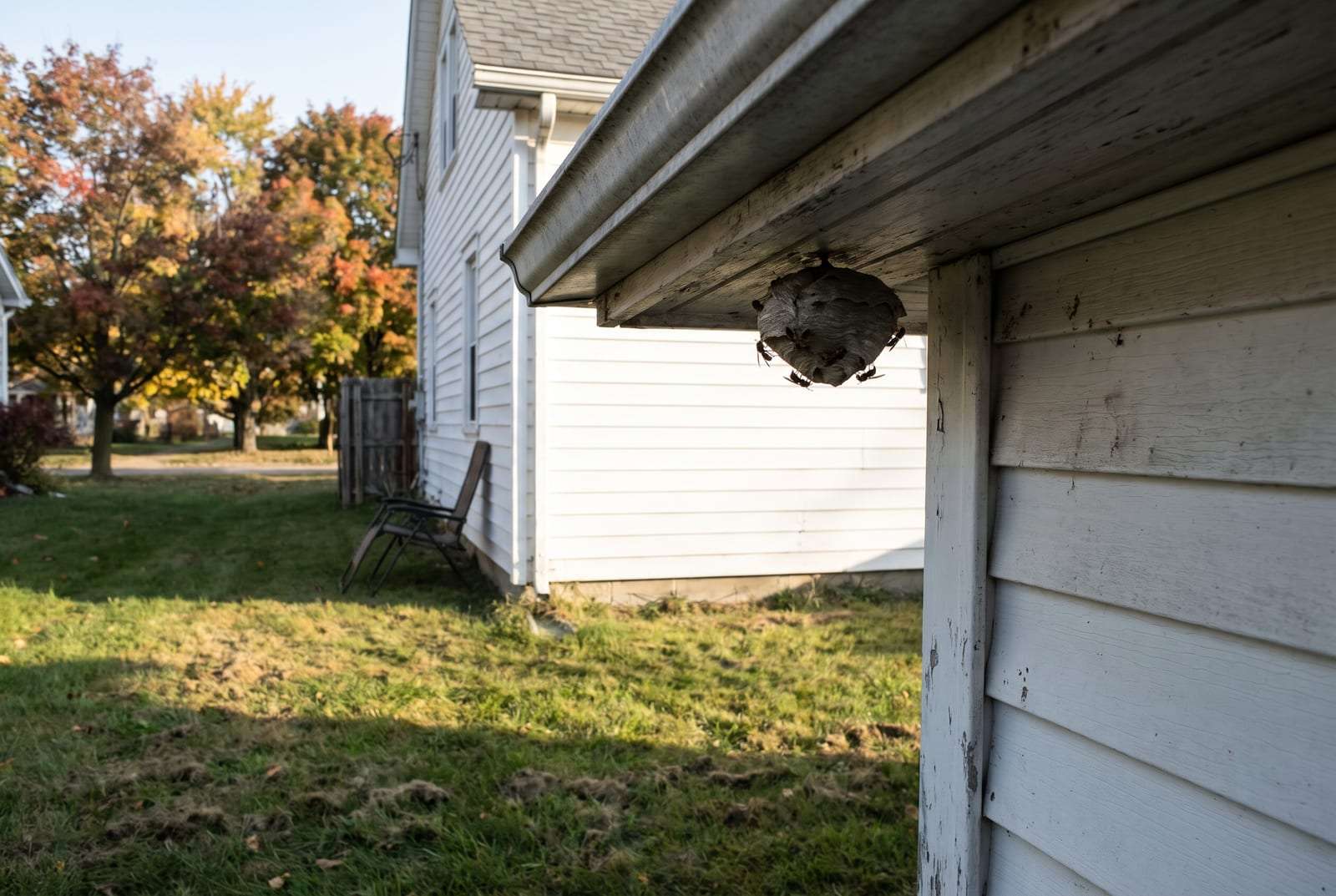
Every wasp and hornet nest starts the same way: a single queen, out of her winter shelter in spring, chewing wood fiber into a few paper cells. By late summer a yellow jacket nest can hold thousands of workers. The Miami Valley’s long, humid summers give colonies time to grow, and the first hard freezes of fall end them; only the new queens survive the winter, and the old nest is not used again.
We remove wasp and hornet nests from around houses: paper wasp combs under eaves and porch ceilings, hornet nests in shrubs and trees, and yellow jacket colonies in wall voids and lawns. Older houses with gaps in their siding, soffits or mortar give yellow jackets a sheltered way into the walls, where a nest can grow unseen until the insects chew through drywall or find their way in around a light fixture.
Which Stinging Insect Built the Nest
The insect decides how defensive the colony will be, where the rest of the nest is likely to be, and whether it needs removing at all; a few minutes of watching from a safe distance usually settles the question.
| Insect | Appearance | Usual nest location | Active season in Ohio | Notes |
|---|---|---|---|---|
| Paper wasp | Slender, long legs dangling in flight; brown or black with yellow or red marks | Open gray comb on a single stalk under eaves, porch ceilings and railings | Spring into early fall | Mild unless the nest is disturbed |
| Yellow jacket | Stout, bright yellow and black, quick in flight | Enclosed paper nest in the ground or a wall void, one busy entrance hole | Spring until hard frost; most aggressive in late summer | Drawn to sweet drinks and food outdoors; stings repeatedly |
| Bald-faced hornet | Black with ivory-white markings on the face and abdomen | Large gray teardrop-shaped nest in trees, shrubs or under eaves | Late spring into fall | Very defensive; the nest can reach the size of a basketball |
| European hornet | Large, reddish-brown and yellow | Hidden in hollow trees, wall voids, attics and barns | Summer into fall | Flies after dark and comes to porch lights |
| Mud dauber | Thread-thin waist; black and yellow or metallic blue | Tubes or lumps of dried mud on walls, garages and sheds | Summer | Solitary and rarely stings |
| Honey bee | Fuzzy and golden-brown, often carrying pollen | Wax comb in hollow trees or wall voids; spring swarms hang in clusters | Early spring into fall; colonies live through winter | Valued pollinators; local beekeepers often collect swarms |
| Carpenter bee | Like a bumblebee, with a shiny black abdomen | Round holes bored into bare or weathered wood: fascia, decks, porch rails | Spring into summer | Males cannot sting; females rarely do |
A nest high in a tree, well away from the house and from anyone’s path, can often be left until the frosts end the colony. A nest beside a door, over a deck, in a play set or inside a wall is a different matter.
Staying Safe Until the Nest Is Gone
Most stings around a house come from stumbling onto a nest, or from trying to deal with one alone.
Sensible Precautions
- Keep well back from the nest and its flight path, and use another door if the nest is beside the one you normally use.
- Keep children and pets away, and tell everyone who uses the yard where the nest is.
- Keep the mower and string trimmer away from a ground nest, since the vibration brings yellow jackets out in force.
- Move outdoor meals and sweet drinks away from wasp activity, and keep trash cans closed.
- From a distance, note where the insects go in and out: a hole in the siding, the mortar or the lawn says a great deal about the nest.
What Not to Try
- Do not spray an unknown nest, or a hole in the ground or a wall, with a store-bought product. A spray that misses the colony only sends the defenders out.
- Do not block or seal a nest entrance. Insects shut inside a wall search for another way out, and it often leads into the house.
- Do not knock a nest down, burn it or flood it, and never work on a nest from a ladder, where a sudden rush of wasps can cause a fall.
- Do not swat at wasps near the nest or stand in front of its entrance.
Anyone stung several times, or who has swelling of the face or throat, trouble breathing or dizziness after a sting, needs emergency medical help at once: call 911.
Allergies, Honey Bees and Carpenter Bees
Not every stinging insect near a house is a wasp, and not everyone can shrug off a sting.
What should someone with a sting allergy do about a nest near the house?
Follow the plan their doctor has given them, keep any prescribed medicine close at hand, and stay well away from the nest and its flight path. Someone else should deal with the nest, while the person with the allergy stays indoors or away from the house.
How can I tell honey bees from wasps?
Honey bees are fuzzy and golden-brown, often with pollen on their legs; wasps and hornets are smooth and shiny, with a narrow waist. Honey bees build wax comb inside hollow trees or walls, and a spring swarm may hang from a branch for a day or two before moving on. They are valued pollinators, and local beekeepers often collect swarms.
Are carpenter bees a danger to the house?
They are a slow danger to its wood. Carpenter bees look like bumblebees with a shiny black abdomen, and the females bore round holes into bare or weathered wood such as fascia boards and deck rails, coming back to the same wood year after year. The males hover and dart at people but cannot sting. Paint or stain on exposed wood discourages them.
Exposed Nests, Wall Voids and Ground Nests
As with all our work, the visit begins with an inspection: naming the insect, finding the nest and every entrance to it, and noting what lies close by, such as a door, a window, a vent or a play area.
In the trade, an exposed nest, such as a paper wasp comb under the eaves or a hornet nest in a shrub, is generally treated first and taken down once the colony is dead, so returning workers find nothing to rebuild around. Nests in wall voids and the ground are treated through their entrance, often with a dust the insects carry inside, and the entrance is left open until activity stops: sealing it too soon traps survivors, who then look for another way out.
Nests are usually treated early or late in the day, when most of the colony is home and the insects are slow. Once activity has stopped for good, the gap a queen used in the siding or soffit is worth closing, so the same opening does not draw another queen in spring.
When a Nest Is Too Close to the House
Keep the household clear of it, then call or send an estimate request: removing nests from eaves, walls and lawns is part of our work around houses across Dayton.