
A Seasonal Guide to Pests Around Dayton
Which pests are usually active around Dayton in each season, and the jobs around the house that help keep them out.
Pests Keep to the Seasons
Most household pests run on a calendar of their own. Termites swarm on warm spring days after rain, wasp nests grow all summer, and mice look for a way inside as the nights cool. Knowing what each season usually brings makes it possible to get ahead of it: a gap sealed in October keeps out the mouse that would have found it in November.
The house matters as much as the weather. An older house on a stone foundation lets in more than a newer one on poured concrete, and a damp basement keeps silverfish and roaches going all year. The seasons set the timing, and the building decides how much gets in.
See What a Month Usually Brings
Choose a month to see which pests are usually active, a few jobs for the house and the service that fits.
Choose a month, then press the button to see what it usually brings.
The Seasons Side by Side
Season by season, these are the pests most often active, the jobs that help keep them out and the service each one falls under. An early warm spell or a late frost can shift everything by a few weeks, so treat the seasons as a guide rather than a timetable.
| Season | Pests active in Dayton | Home tasks | Related service |
|---|---|---|---|
| Spring (March–May) | Termite swarmers, ants, stink bugs and boxelder bugs leaving the walls, wasp queens starting nests | Clear gutters, pull mulch back from the siding, check the foundation for mud tubes | Termite Control, General Pest Control |
| Summer (June–August) | Paper wasps, yellow jackets and hornets, mosquitoes, ants, cockroaches | Empty standing water weekly, watch nests from a distance, keep pet food sealed | Wasps and Hornets, General Pest Control |
| Autumn (September–November) | Yellow jackets, stink bugs, boxelder bugs, spiders, mice and rats moving in | Fit door sweeps, seal foundation gaps, check vents, move firewood away from the house | Rodent Control |
| Winter (December–February) | House mice, Norway rats, German cockroaches, bed bugs after travel | Look for droppings, keep traps out of reach, inspect luggage after trips | Rodent Control, Bed Bug Treatment |
Rain, Thaw and the Early Ants of Spring
Spring comes in fits and starts: a thaw, a hard frost, then weeks of rain. Ants are usually the first real trouble. Odorous house ants and pavement ants follow the warm afternoons and wet weather indoors, trailing along baseboards and counter edges to anything sweet or greasy. A trail that keeps returning after the counters are clean leads back to a nest in a wall or under the floor, and the nest is what has to be dealt with.
Swarm season for eastern subterranean termites, the termite found across Ohio, peaks in April and May, usually on a warm, still day after rain. Winged termites inside the house, or little piles of their shed wings on a sill, point to a colony already at work in the structure or the soil beneath it. They are easily mistaken for flying ants, so save a few in a jar or a zipped bag. Leave any mud tubes unbroken and photograph them, because they show the active route, and finding that route is where termite control begins.
A wet spring also fills clogged gutters, low spots and forgotten buckets, and the first mosquitoes breed in any water that stands for a week. Water pooling against the foundation does more harm than the mosquitoes, though. It keeps the soil damp where termites forage, and it seeps into basements, where silverfish and cockroaches thrive in the humidity.
Why do ants come indoors after a heavy spring rain?
Saturated soil floods their nests, so a colony moves its workers and young to drier ground, and a wall void or the space under a kitchen floor will serve. Rain also washes away much of what they feed on outdoors. Clean counters help, but a trail that carries on once the weather dries out usually means a nest close by, which is work for general pest control.
Why are mosquitoes worse after a wet spring?
More standing water means more places to breed, and many mosquito eggs laid on damp ground or on the inside wall of a container hatch once rain floods them. Tipping out containers, clearing gutters and filling low spots that hold water for more than a few days all cut the numbers in a yard.
Does a damp basement draw pests?
Yes. Silverfish, cockroaches and the spiders that hunt them all favor humid air, and moisture in the framing invites termites and carpenter ants. A dehumidifier that holds the relative humidity near 50 percent, a dry sill plate and storage in plastic bins rather than cardboard make a basement far less welcoming.
Will drying out the basement solve the problem on its own?
It goes a long way with silverfish and other insects that depend on moisture. It will not close the gaps that mice use or remove a termite colony already feeding in the wood, and both of those need work of their own.
Wasp Nests and Mosquitoes in the Heat of Summer
By midsummer the colonies that started small in spring are at full strength. Paper wasps hang open combs of gray paper cells from eaves, porch ceilings and deck railings. Yellow jackets nest out of sight, in the ground or inside a wall, and come and go through a single hole. Bald-faced hornets build the large gray paper nests seen in trees, in shrubs and under overhangs.
Never spray or block an unknown nest, and never plug a hole that insects fly into: yellow jackets shut inside a wall can chew through to the rooms. Keep children and pets back, note where the insects come and go, and leave wasp and hornet nest removal to someone in protective gear.
Mosquitoes peak in the humid weeks of July and August. Many of those biting in a yard bred close by, in water no deeper than a bottle cap: gutters, plant saucers, tarps, tires and toys. Tipping out standing water once a week breaks the cycle, since the larvae need about a week to become adults, and mosquito control for yards is part of our general pest control.
Cooler Nights and the Search for a Way In
Autumn is when the outdoors starts moving inside. As the nights cool, stink bugs and boxelder bugs gather on the sunny south and west walls of a house and work their way in around window frames, siding, soffits and attic vents. Whatever reaches the walls now spends the winter there and reappears on warm days until spring.
Yellow jackets are at their most defensive in early autumn. Their colonies reach full size just as natural food runs short, which is why they crowd picnic tables and trash cans. Frost ends the colony, and the old nest is never used again; the new queens that will start next year’s nests spend the winter under bark or inside a shed.
Mice are the bigger matter. A house mouse can pass through a gap about a quarter of an inch wide, and as the nights fall toward freezing, mice follow foundations, utility lines and garage doors in search of warmth. Norway rats burrow beside foundations and under sheds, then follow pipes into basements. Closing those entry points is the part of rodent control that lasts.
A Fall Seal-Up List for Before the Freeze
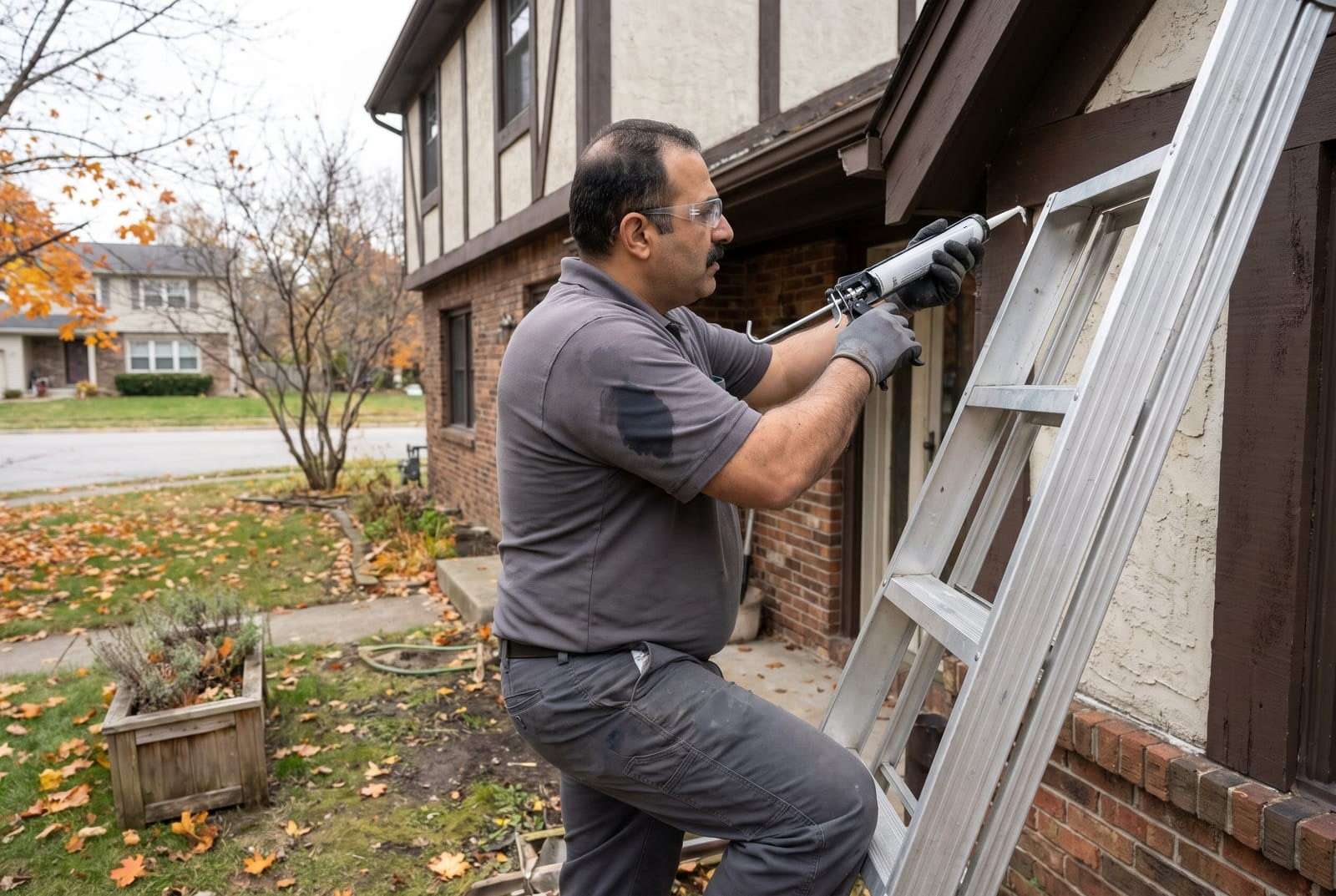
Most of the openings that pests use in winter can be found in an afternoon, and many are simple to close. Caulk and sealant set poorly in the cold, so the work goes best while the weather is still mild. Walk the outside of the house with a flashlight and go through these:
- Door sweeps. Fit or replace the sweep on every exterior door, the garage service door included. Where daylight shows under a door, a mouse can follow it in.
- Foundation gaps. Look where pipes, cables, the air conditioner line and the dryer vent pass through the wall, and where mortar has crumbled between bricks or stones. Pack openings with copper mesh or steel wool before sealing over them.
- Vents. Check that the dryer vent flap closes on its own, and that attic, soffit and foundation vents still have intact screens.
- Firewood storage. Stack firewood off the ground and well away from the house, never against the siding.
- Gutters. Clear them once the trees are bare, and make sure the downspouts carry water several feet from the foundation.
Small gaps make a fair weekend job. Openings high on the house, inside a crawl space or wider than a few inches call for proper exclusion work, with materials that mice and rats cannot chew through.
The Winter Months Inside the House
Winter quiets the yard but not the house. Mice and rats that moved in during the fall nest in insulation, wall voids and stored boxes, and they keep breeding through the cold months. Droppings along a basement wall, chewed food packages and scratching in a ceiling after dark are the usual signs.
German cockroaches take no notice of the season. They live entirely indoors, close to warmth, water and food: behind refrigerators, under sinks and in the hinges of cabinets. In apartment buildings they travel between units along plumbing lines and through shared walls, which is why treating one kitchen alone so often fails.
Bed bugs keep no season, but holiday travel and visitors carry them from place to place. Check mattress seams and luggage after a trip. If you find them, do not set off a fogger or move to another room to sleep: both tend to scatter them, and bed bug treatment goes best when they are still where they were found.
How Miami Valley Weather Pushes Pests Indoors
Dayton’s weather works on a house from two directions. Summers here are warm and humid, and that moisture settles in basements and crawl spaces, where cool walls and floors pull water out of the air. Damp framing, wet sill plates and sweating pipes suit silverfish, cockroaches, carpenter ants and termites, and a basement that stays humid all summer stays inviting well into the fall.
Winters swing back and forth across the freezing mark again and again. Each freeze and thaw works water into mortar joints, foundation cracks and the gaps around pipes, and pries them a little wider. In houses on stone or brick foundations, years of this leave openings that mice find long before anyone else notices them.
The two seasons work together: moisture draws pests to the foundation in summer, and the cold pushes them through it in winter. That is why so much good pest control is plain upkeep, from drier basements and sound mortar to tight doors and working gutters. When a problem goes beyond what sealing and drying can fix, the work starts with an inspection to find the way in, the first stage of How We Work.
Ahead of the Next Season
When a season brings in more than sealing and cleaning can handle, a phone call or an estimate request is the next step.